April 3, 2026
Executive Function in ADHD & Autism: A Social Model Lense
Executive function is often described as if it were a private flaw: a broken internal manager, a lack of discipline, a personal failure to organize life properly. That frame is too small.
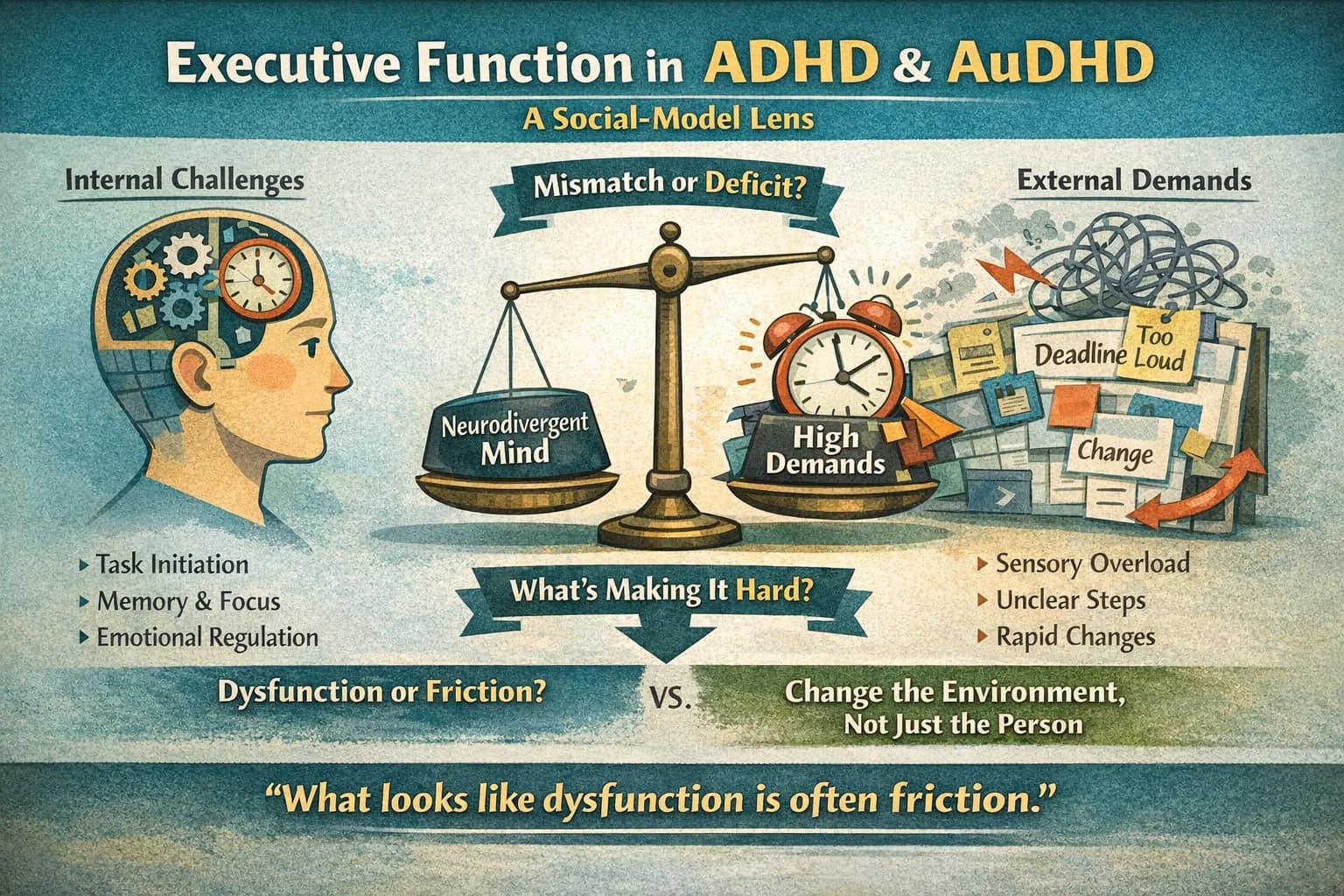
From a social model point of view, executive function differences in ADHD and AuDHD are not just internal deficits. They become disabling when the environment is built around one narrow standard for how a mind should plan, start, shift, remember, regulate, and follow through.
That changes the question.
Not:
What is wrong with this person?
But:
What is making this person’s nervous system work so hard?
A person can be bright, capable, motivated, and still struggle to begin a task, sequence steps, manage time, recover from interruption, hold multiple demands in mind, or regulate emotion under pressure. That does not automatically mean laziness or lack of care. It may mean the demands exceed what their executive system can access in that moment.
With ADHD, executive function differences often show up around initiation, prioritization, working memory, time sense, inhibition, pacing, and consistency. Many people with ADHD can perform extremely well under the right conditions: interest, urgency, novelty, pressure, meaning. Then, in a different context, they may lose access to that same capacity. The issue is often not raw ability, but reliable access to ability.
With AuDHD, the picture can be more layered. ADHD-related difficulty with regulation and follow-through may sit alongside autism-related friction around change, sensory load, uncertainty, transitions, and competing demands. That can create a push-pull dynamic: craving stimulation while needing predictability, wanting movement while resisting disruption, needing structure while struggling to generate it.
This is why “can do” is such a weak measure. Many ADHD and AuDHD people can do the thing. The more useful question is whether they can do it consistently, on demand, in that environment, without paying a steep cost in energy, shame, or recovery time.
From this lens, what gets called procrastination may be task-initiation friction. What gets called avoidance may be overload. What gets called inconsistency may be state-dependent access. What gets called irresponsibility may be working-memory strain, transition cost, or executive bandwidth collapse.
The social model does not deny real impairment. It widens the frame. It reminds us that the environment is not neutral. Workplaces, schools, and relationships often reward self-generated structure, rapid switching, sensory tolerance, and steady output, then treat difficulty in those areas as a character problem instead of a design problem.
That is why this lens is useful in education, coaching, and support. It moves the conversation away from blame and toward design. Better questions tend to follow:
Is the task clear enough?
Is it broken down enough?
Is the sensory load too high?
Is there too much ambiguity?
Too much switching?
Too much self-structuring required?
Are we measuring output while ignoring effort cost?
The cleanest way to say it is this:
Executive function differences in ADHD and AuDHD are often treated as personal deficits when they are just as often a mismatch between a neurodivergent nervous system and environments built for a different kind of mind.
Or more simply:
What looks like dysfunction is often friction.
This does not make the struggle less real. It makes the explanation more accurate, and the response more humane and effective.
Comments (1)
Aaron · Jun 5, 2026
"That can create a push-pull dynamic: craving stimulation while needing predictability, wanting movement while resisting disruption, needing structure while struggling to generate it." BAM. Welcome to my nightmare! lol